

6 Best AI Roleplay Tools for Character Creation Past the 3,200-Character Cap
Published: · Updated:
If you make character voices, you already know the voice is only half the job. A rival from your favourite anime, a villain from a game you love or a narrator you invented will only sound right if the character behind the voice holds together. So you design that character, hit Save, and watch half the profile disappear before you ever get to giving that character a voice. If that pain rings true, this guide will help.
We compare today’s top AI role-play tools for character creation (relying on published context limits and memory designs, not lab tests) to reveal which ones keep your lore intact. Character.AI still passes only the first 3,200 characters of a Definition to the model, and many creators report reliable recall closer to 2,700-2,900, even though the field accepts up to 32,000. The six platforms below tackle that squeeze by separating permanent identity, triggered lore, and rolling story memory.
What the 3,200-Character Cap Actually Measures
Character.AI says only the first 3,200 characters in a Definition reach the model, yet creators often see reliable recall closer to 2,700-2,900. This figure covers a single profile box, not the whole conversation. Messages, instructions and recent chat share a separate token budget.
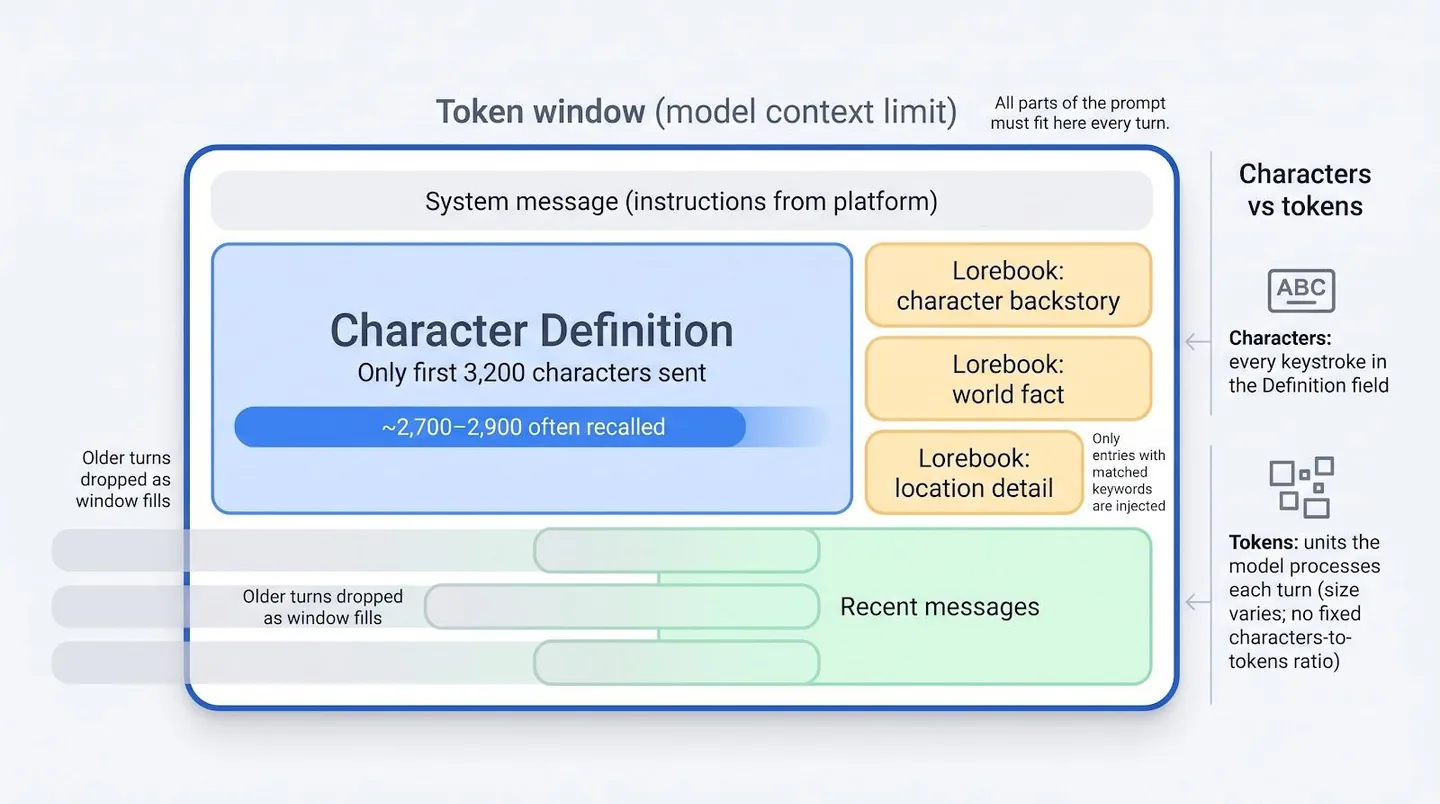
The 3,200-character figure comes from Character.AI's January 2024 AMA recap, while its help pages describe a 32,000-character field, which creates understandable confusion. Characters count every keystroke you save in that box. Tokens are the bite-sized units the model processes each turn, so there’s no fixed character-to-token ratio.
On every turn, the model has to fit your Definition, the system message, any triggered lore, and the latest dialogue inside one token window. When that window fills, new lines push older ones out, so a long Definition alone never guarantees recall.
The fix is structure, not one bloated profile: keep permanent identity short and let lore load only when a scene needs it. The six tools below build that idea in with larger windows, smarter retrieval, or both, so your cast’s memory stays intact as the story grows.
How We Chose the Best AI Roleplay for Character Creation
We began with a single rule: each platform had to move beyond a cramped Definition box, either by publishing a larger context window or by adding structured lore and memory layers.
Next, we scored every candidate with a 100-point rubric shaped by real creator workflows: character and world-building depth (25 percent), context and memory design (20 percent), multi-character and scenario support (15 percent), steering and editability (10 percent), setup simplicity (20 percent), and pricing transparency plus documentation recency (10 percent).
We relied only on first-party documentation, release notes, and pricing pages. Tools that lagged behind stronger peers didn’t make the list.
We ran no latency or prose-quality tests. The rankings focus on published limits and clearly stated features. The six remaining tools all give your cast room to grow without making you reverse engineer hidden prompts.
The Six Tools at a Glance
Here is a quick reference to match each platform with your workflow before you dive into the full reviews.
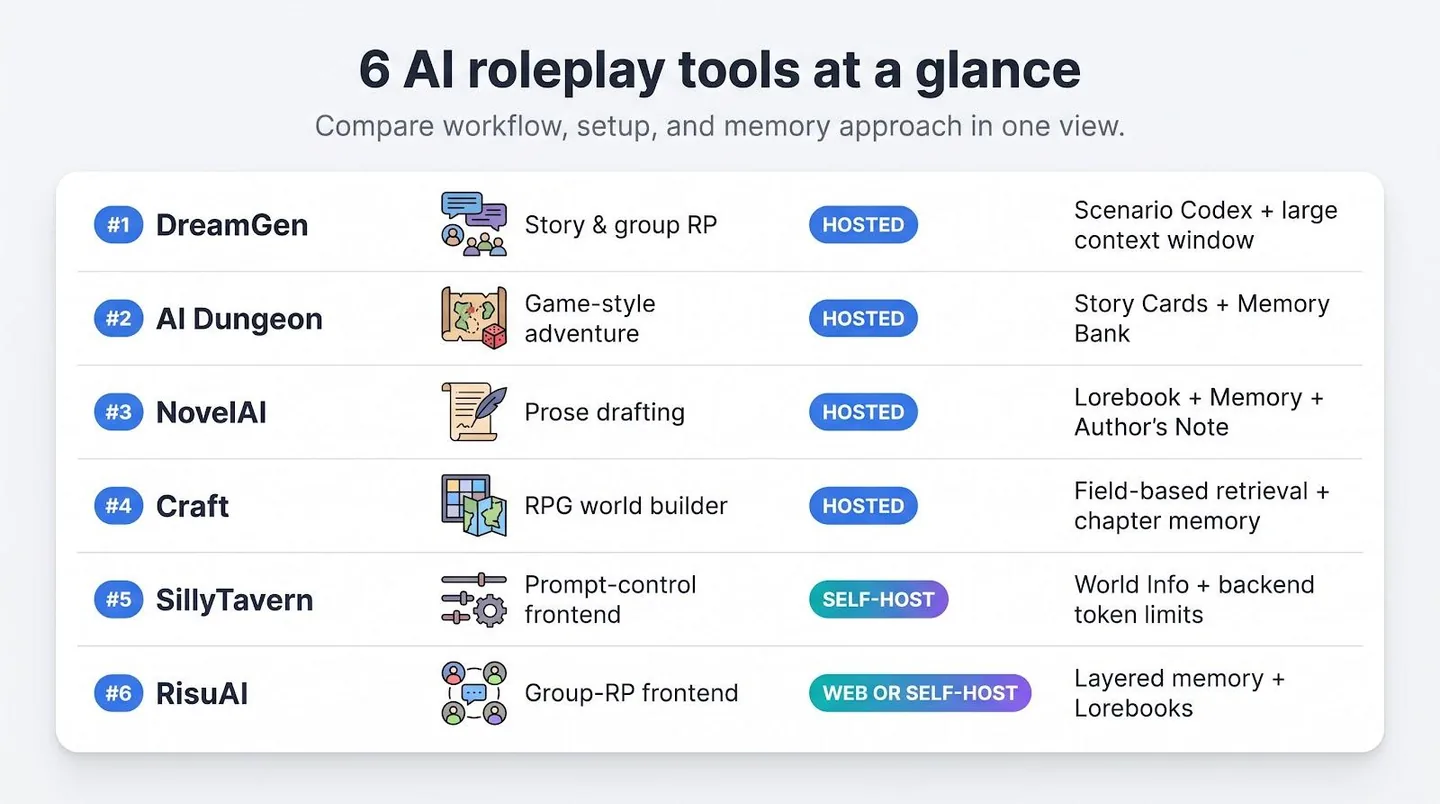
| Rank | Tool | Primary workflow | Context / memory approach | Multi-character | Setup | Pricing shape | Main limitation |
|---|---|---|---|---|---|---|---|
| 1 | DreamGen | Story & group RP | Up to 60,000 tokens; Scenario Codex | Yes | Hosted | Starter / Advanced / Pro tiers | Smaller public library |
| 2 | AI Dungeon | Game-style adventure | Up to 32,000 tokens + Story Cards | Yes | Hosted | $0-$99 monthly tiers | Context varies by tier |
| 3 | NovelAI | Prose drafting | 28,672-token max; Lorebook | Limited | Hosted | $10-$25 monthly tiers | Manual context management |
| 4 | Craft | RPG world builder | Model-dependent window + chapter memory | Yes | Hosted | $0-$199 monthly plans | Beta complexity |
| 5 | SillyTavern | Prompt-control frontend | Model-dependent; World Info | Yes | Self-host | Open-source; backend cost | Setup overhead |
| 6 | RisuAI | Group-RP frontend | Provider-dependent; layered memory | Yes | Web or self-host | Open-source; provider cost | Thinner docs |
Token windows, retrieval systems, and profile limits measure different things, so treat these figures as starting points, not guarantees.
1. DreamGen: Multi-Character Worldbuilding With Hosted Simplicity
DreamGen pairs purpose-trained fiction models with an interface that lets you spin up a new cast in minutes. Role-Play Mode supports several speakers, a narrator, and quick NPCs in the same chat. Switch to Story Writing Mode and the scene shifts into third-person prose without dropping continuity.
At the centre sits the Scenario Codex: a wiki-style vault for characters, locations, items, maps, dialogue samples, and alternate openings. Because entries remain outside the live prompt until a cue appears, permanent identity and triggered lore never compete for space. Pro subscribers can send up to 30,000 tokens per turn with GLM 5.2 or 60,000 tokens with Gemma 4 31B. Sprawling campaigns flow without constant pruning, and the Codex can grow with the narrative.
A Scenario Wizard builds starter files for you, and a Role-Play Assistant offers inline plot nudges when momentum stalls. Documented gaps remain: the public scenario library is still small, text-to-speech is missing, and there is no dedicated mobile app.
For a wider market view, see DreamGen’s own guide to the Best AI Roleplay Chatbots. If you juggle a recurring ensemble and want hosted convenience instead of hardware tinkering, DreamGen offers a ready-made playground where characters stay on script.
2. AI Dungeon: Adventure-First Character Arcs
AI Dungeon turns each chat into a game-master style session filled with dice-free twists and branching paths. Context grows with membership, up to 32,000 tokens on the top tiers, and credits can raise it further on some story generators. This space feeds a layered memory system: always-on Plot Essentials, keyword-triggered Story Cards, a rolling Story Summary, and a long-term Memory Bank.
A built-in Context Viewer shows which cards reach the model on every turn. When the token budget overflows, lower-priority cards drop first, so core facts stay anchored even in marathon adventures.
Pricing is clear. Wanderer costs nothing, Journey is $14.99 per month, and Legend, Mythic, and Ultimate cost $29.99, $49.99, and $99.99 per month. Higher tiers unlock larger windows, faster credit refresh, and more model choices.
There is a trade-off. Managing tags, priorities, and card keywords takes practice, and effective context still depends on the model you pick for each adventure. Skip a tag and a villain’s card may disappear until the right cue returns.
If you want a game-master vibe, branching quests, and precise control over which lore appears when, AI Dungeon offers a flexible playground, provided you are ready to master its many levers.
3. NovelAI: Prose-First Character Development
NovelAI feels like a focused writing studio wrapped around a language model. Open a blank page, drop in a scene, and the editor invites you to adjust voice, pacing, and mood line by line.
The top Opus tier grants 28,672 tokens per call. That is enough for multi-chapter arcs, yet raw size is only step one. The Lorebook drives the process: tag characters, locations, rules, or factions, assign activation keys, and decide whether each entry appears always, conditionally, or only on a precise phrase. Memory and Author’s Note fields add two more shelves: one for the protagonist’s current mindset, the other for meta instructions.
A Context Viewer shows the exact prompt before you click Generate. If the story drifts, move a Lorebook entry from “always” to “conditional” or edit its keys. No wholesale rewrite needed.
Pricing is transparent: Tablet $10 a month, Scroll $15, Opus $25. Higher tiers unlock larger windows and faster generation while keeping the same workflow.
Once personality and sample dialogue feel stable, the next step is voice production. This guide on how to create a consistent AI character voice covers that hand-off.
NovelAI suits fiction and fan-fiction writers who want precise control over when and how each scrap of canon reaches the page. Because the editor saves every revision, you can roll back experimental branches and compare alternate lore activations without losing earlier drafts.
4. Craft: Structured RPG Characters and Worlds
Craft treats role-play like game design. Every element, whether a character, rule, locale or single sword, lives in its own file with its own editable fields. A noble’s hidden lineage can rest in “Backstory” until a scene needs it, and combat stats stay in “Abilities.”
Context depends on the model you connect, yet Craft adds extra memory. GM instructions sit outside everyday chat. Chapters store recent turns, and a semantic research engine retrieves only the facts a scene requests, so prompts stay lean while still recalling last season’s betrayals.
Harness 2, released on 29 October 2026, tightened state tracking so NPC goals and inventories surface mid-session.
Pricing spans six tiers: Free, Starter $19.99, Plus $39.99, Pro $59.99, Max $99.99, and Ultra $199.99 per month, each blending daily energy with optional credits. Expect a learning curve: Craft is in open beta, and some interface edges remain rough.
If you treat lore like code, Craft offers granular control, searchable memory and model flexibility, all without juggling external spreadsheets or losing track of which dagger sits in which vault.
5. SillyTavern: Granular Prompt and Backend Control
SillyTavern is a self-hosted frontend for creators who want every dial that hosted suites hide. A character card starts the process, holding description, personality, scenario, sample dialogue, notes and alternate greetings. SillyTavern passes the entire card to whichever model you connect, whether a local GPU, a paid API or a third-party cloud. There is no fixed 3,200-character ceiling because total context equals the limit of your chosen backend.
World Info adds a second layer. Lore can bind to one persona, the full cast or a single chat, and it can fire in list order or from a pooled queue. Group chats include manual or natural speaker sequencing, handy for councils, tavern scenes or chaotic brawls.
Setup swaps speed for control. Clone the AGPL repo, follow the install guide, point the UI at your endpoint, then tune presets for temperature, token budget, insertion position and role tags. Many hosted tools lock those parameters.
SillyTavern is open-source software, so costs come from your compute or API usage, not from the project itself. That freedom also means support comes from community docs and Discord instead of a ticket queue. If you enjoy running your own backend or testing new open-weight models, SillyTavern offers a sandbox where lore placement and prompt anatomy are firmly under your command, as long as you are willing to spend an afternoon on initial setup.
6. RisuAI: Group Roleplay With Layered Memory
RisuAI bridges plug-and-play convenience with code-heavy freedom. You can launch a free web instance in minutes or clone the GPL-licensed repository and host it beside any model server, whether OpenAI today or a local Llama tomorrow. Total context depends on the backend you supply.
The interface centres on group chats. Each speaker holds a character card. Lorebooks inject world facts when keywords fire within the last five messages, sharing an 800-token budget, and a compression-based long-term memory keeps early chapters available without bloating the prompt. Built-in HypaMemory and SupaMemory handle this compression, summarising older turns to preserve context.
Prompt order, variables and regex conditions sit in clear view. Need a battle chant to override small talk? Re-order the template. Want the tavern’s mood to shift only after a bar-brawl keyword? Add a condition. One-click role-colour themes polish readability during crowded exchanges.
RisuAI has no subscription fee. Costs come from the API or hardware you connect. That freedom carries trade-offs: documentation trails slicker rivals, and new users may spend an evening tuning YAML before tone and temperature feel right.
If you value multi-character banter, open-source ethics and the power to swap models as new contenders arrive, RisuAI offers an evolving space, provided you are willing to trade immediate polish for full control over memory layers and prompt anatomy.
Why Memory Architecture Beats One Big Number
Permanent identity, triggered lore, current scene state and compressed history: these four layers decide whether an AI remembers its own name, not the headline token count.
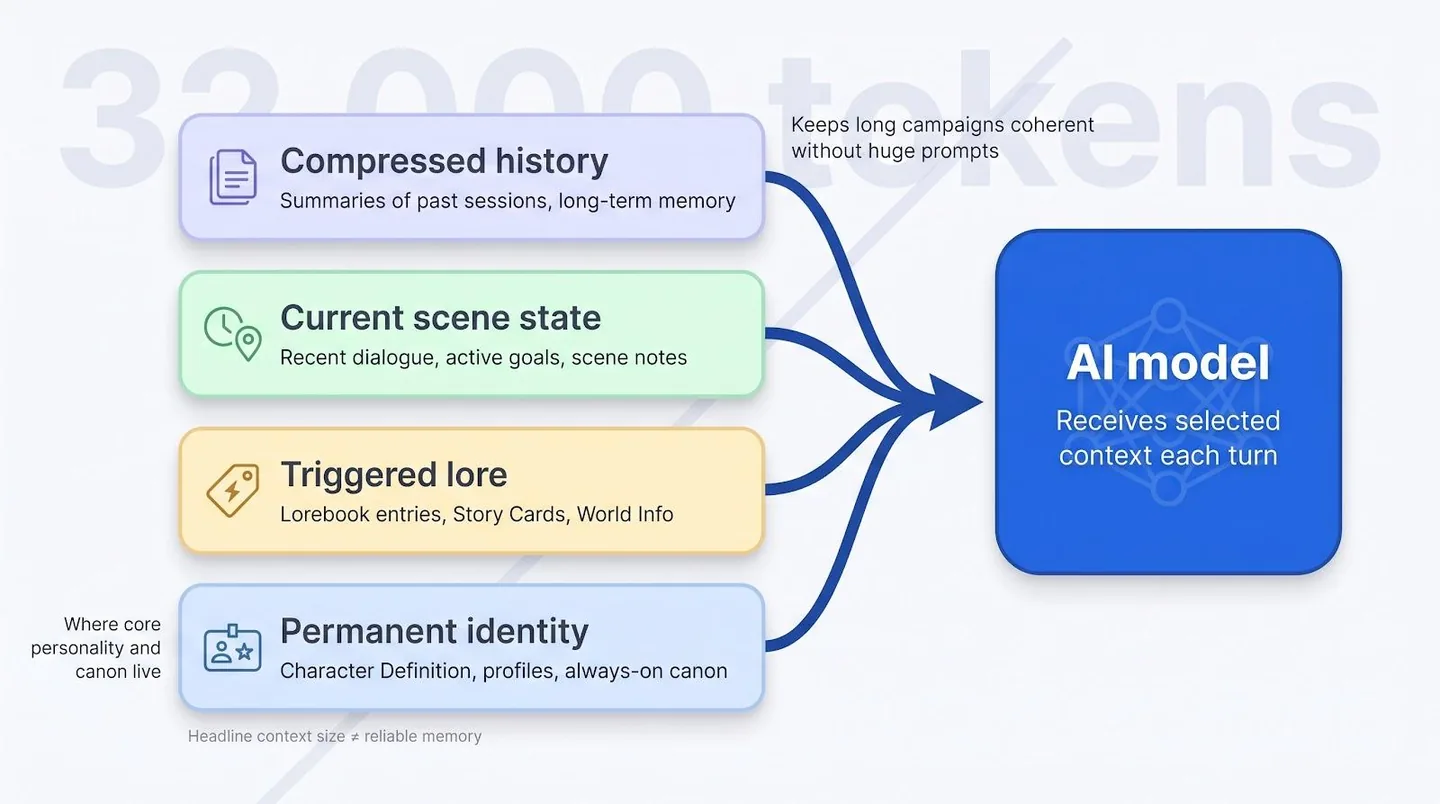
Character.AI still recognises only 3,200 characters in a Definition, even though the field accepts far more. Academic studies on long-context models also show that performance drops when key facts land in the middle of very long prompts, so sheer size alone cannot guarantee recall.
Each of our six tools handles the four layers differently:
- DreamGen uses a Scenario Codex for always-on identity and keyword lore.
- AI Dungeon splits Plot Essentials, Story Cards, summaries and a Memory Bank.
- NovelAI blends Lorebook, Memory and Author’s Note with a Context Viewer.
- Craft retrieves only the specific fields a scene requests.
- SillyTavern and RisuAI let you set card order, triggers and insertion positions by hand.
Organise the facts first, then worry about window size.
How to Pick the Right Tool in One Coffee Break
- Count active characters.
- Single-voice prose or internal monologue → NovelAI
- Recurring ensemble or rotating party → DreamGen, SillyTavern or RisuAI
- Rule-driven worlds with maps or game mechanics → AI Dungeon or Craft
- Decide where canon should live.
- Always-on identity → profile field or codex
- Location or item facts → Lorebook, Story Card or World Info
- Scene-only notes → memory bank, chapter summary or scene-state file
- Past sessions → compressed history or long-term memory module
- Balance convenience against control.Hosted suites launch in minutes but lock model settings. Self-hosted fronts need setup time yet let you tweak every prompt lever. Before you commit, check the full cost: subscription tier, energy or credit limits, plus any external API or hardware fees. Export a backup of your character files so your cast survives future platform changes.
Conclusion
Great character work lives or dies on memory, not headline token counts. DreamGen shines for hosted multi-character worlds. AI Dungeon offers game-master depth. NovelAI focuses on prose-first precision. Craft stores lore like data. SillyTavern hands you every prompt lever. RisuAI keeps the workflow open and growing. Pick the tool that fits your cast and workflow, export regular backups, and once your character's personality is locked in, bring it back to Voicestars and give it a voice that matches who they are.


