
FROM OUR BLOG
FROM OUR BLOG
FROM OUR BLOG
AI-Driven Music Production Explained: A Deep Dive into Data-Driven Creation with MusicAI
Dec 15, 2025
Why AI Is Reshaping Music Production
The rise of AI is changing how music is made. For decades, producing a track meant hiring musicians, booking studio time, and spending hours on mixing and mastering. Now, an AI music generator can shorten that process dramatically. Users no longer need deep musical training. They can start with a prompt or an idea — and let AI compose, arrange, and export music.
This shift is part of a broader wave: generative-AI tools now allow creators to generate original music through data-driven algorithms. According to recent market studies, the global AI Music Generator market — once relatively modest — is growing rapidly, driven by advances in machine learning and rising demand for digital, on-demand music.
In this article, I analyze how intelligent data powers platforms, explore how they influence modern music trends, and reflect on what this means for music creators, listeners, and the industry as a whole.
The Challenge in Traditional Music Creation
Traditional music production is resource-intensive. Think about it: writing melody, arranging instrumentation, mixing, mastering, exporting — each step demands skill, time, and tools. This often limits music-making to professionals or serious hobbyists.
Moreover, in today’s digital-first music market, demand for quick, cheap, and versatile music is growing. Content creators, video producers, game developers, advertisers — all need music fast. Traditional pipelines struggle to meet that demand economically.
Also, despite demand, many independent creators lack access to full-scale production resources. The barrier to entry remains high. That restricts diversity of musical output.
These constraints — cost, time, skill requirement, access — have created a gap between demand (for accessible, affordable music) and supply (traditional, resource-heavy production). AI music generation tools aim to fill that gap.
An Example in Practice: MusicAI in Action
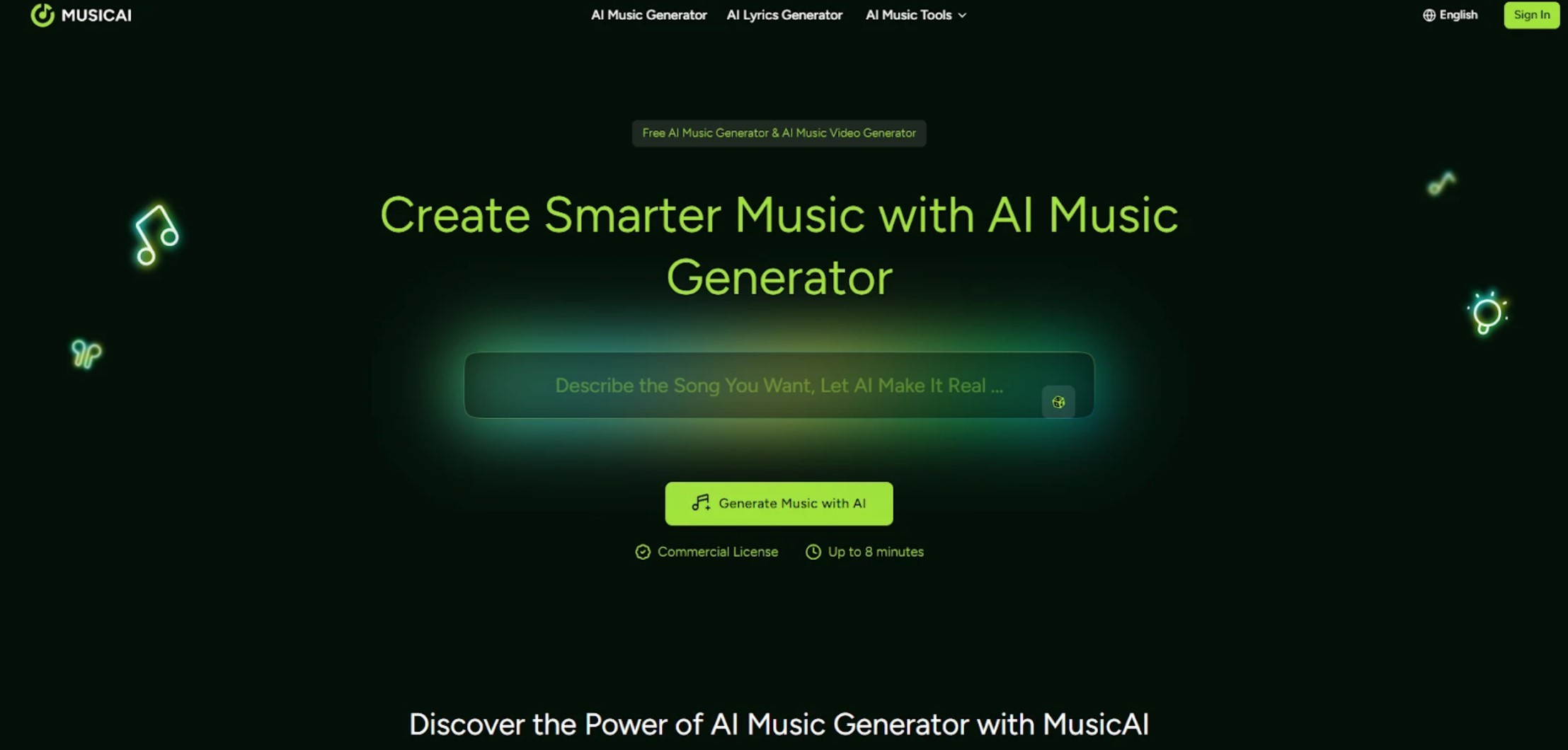
I personally tested MusicAI with a small project. I started with a simple prompt: “melancholic electronic track, 90 BPM, ambient pads, soft lead melody, 2 minutes long”. Within seconds, MusicAI generated a MIDI-structured track. I exported it in WAV format, then imported into my DAW for minor adjustments. Total time from prompt to export: under five minutes. File size (WAV, 44.1 kHz stereo) about 8 MB.
Next, I tried a slightly more complex prompt: “upbeat lo-fi hip-hop beat, 80 BPM, sampled vinyl drums, warm bass, simple piano riff”. MusicAI produced a loopable 30-second bar that felt ready for a YouTube short or background music for a vlog.
Through these small experiments, I realized: with minimal effort, one can generate usable music for social media, indie games, background scores — without needing deep musical training. This aligns with broader industry shifts.
Strengths and Limitations of AI-based Music Creation
What Works Well
Speed and Efficiency: As shown above, MusicAI dramatically reduces production time — from hours/days to minutes.
Lower Barrier to Entry: Anyone can produce a track, even without musical knowledge.
Variety & Flexibility: AI can output in multiple formats (MIDI, WAV, MP3), allow for genre-specific presets or custom prompts, and adapt to different use cases (ambient, electronic, lo-fi, cinematic, etc.). This aligns with industry-wide characterizations of AI music generators supporting simple melodies, complex compositions, and hybrid outputs.
Scalability & Commercial Use Potential: Because the cost and time per track are low, creators can scale output — useful for YouTube channels, indie game soundtracks, ads, background music libraries, etc.
Where Challenges Remain
Musical Originality & Artistic Depth: While AI can generate coherent tracks, human composers often bring soul, nuance, and emotional depth. Some works produced by AI still lack the subtlety or intention of human-crafted music. Reviews note that quality evaluation remains a challenge.
Copyright & Ethical Concerns: Because AI is trained on existing music, questions remain about data provenance, rights, and licensing. The industry has flagged these issues as major barriers to widespread adoption.
Integration Needs: To make AI-generated music truly production-ready, users often still need to use a DAW, perform mixing/mastering, or adjust instrumentation for their specific use case.
Who Benefits Most from MusicAI and Similar Tools
AI music generators are not a one-size-fits-all solution. They are especially well-suited for:
Content creators & video producers who need quick, royalty-free or custom music (e.g., for vlogs, podcasts, shorts).
Indie game developers or small studios seeking background music or ambiance without budget for custom scoring.
Small businesses / social-media influencers needing background music for ads, stories, reels — but lacking budget to hire musicians.
Aspiring musicians or hobbyists who want to experiment, sketch song ideas, or build rough drafts without deep music theory knowledge.
Producers seeking fast prototyping — AI can generate ideas, motifs or chord progressions that human producers then flesh out.
In short: anyone who values speed, low cost, and convenience — even if they sacrifice some of the handcrafted polish of traditional composition.
Why AI-Driven Music Production Is Significant for the Industry
The growth of AI music generation is not just a novelty — it reflects larger structural shifts in the music market. According to recent industry forecasts, the global AI music generator market was valued at approximately USD 1.81 billion in 2024, and is projected to reach around USD 9.35 billion by 2032.
Another report estimates that generative-AI music (so-called “Gen-AI music”) will expand rapidly through the 2020s and beyond, as demand increases for scalable content, personalized music experiences, and cost-effective production.
For the industry, this shift means:
Democratization of music creation — more people can produce music outside traditional gatekeepers (labels, studios).
New revenue streams — AI-generated music can feed into background-music libraries, game soundtracks, video content, apps, ads, and more.
Higher supply to meet demand — the explosion of digital content (video, games, VR, social) requires massive amounts of music — AI helps meet that.
Potential disruption of traditional roles — composers, session musicians, licensing houses may need to adapt to a changing ecosystem where AI-driven music competes directly.
Thus, for companies, creators, and distributors, AI-powered tools represent more than convenience — they represent transformation of the value chain.
Practical Advice: Using MusicAI Effectively
From my testing and broader research, here are a few suggestions for using MusicAI (or similar AI music generators) effectively:
Start with a clear prompt: specify mood, genre, tempo, instrumentation. The more precise the prompt, the more usable the output.
Treat AI output as draft material: use the generated track as a skeleton — then refine in a DAW with mixing, layering, effects to add human touch.
Use for short-form content: ideal for video backgrounds, social media shorts, game ambience, podcast intros — places where you need inexpensive, fast music.
Combine with human creativity: AI works best when it's a co-pilot, not a replacement. Use AI for brainstorming, then add human decisions (arrangement, dynamics, emotion, structure).
Be aware of licensing & ethical considerations: check the license provided by the tool, ensure proper attribution/rights if you plan to publish or monetize.
What This Means for Emerging Music Trends
AI music generators are already influencing which types of music become popular. As demand for digital content, short videos, streaming, and games grows, there is greater need for:
Background music (lo-fi, ambient, chill beats)
Short loops and hooks suitable for social media and short-form video
Music that can be customized to mood or brand aesthetic
AI tools naturally align with these demands: they provide affordable, scalable, and customizable music that fits modern digital consumption habits.
This trend likely will accelerate. As generative AI quality improves and licensing models stabilize, more creators — even those without musical background — will enter music production, diversifying content and broadening the types of music available.
Conclusion: AI Music Generation as a Catalyst, Not a Replacement
AI-powered tools like MusicAI do not promise to replace human composers. Instead, they act as catalysts — lowering barriers, accelerating workflows, and opening up opportunities for a far broader group of creators. For background music, short-form content, indie games, and social media, AI-generated music offers a practical solution.
At the same time, human musicians and producers retain a role in refining, enriching, and personalizing AI output. The most compelling music of the future may come from hybrid workflows: AI-driven generative drafts + human creativity and emotional nuance.
As the global AI music generator market scales — projected to grow several-fold in the next decade — we are likely only at the beginning of a transformation. For creators, businesses, and listeners, that means more music, more diversity, and more opportunities.
import StickyCTA from "https://framer.com/m/StickyCTA-oTce.js@Ywd2H0KGFiYPQhkS5HUJ"
Why AI Is Reshaping Music Production
The rise of AI is changing how music is made. For decades, producing a track meant hiring musicians, booking studio time, and spending hours on mixing and mastering. Now, an AI music generator can shorten that process dramatically. Users no longer need deep musical training. They can start with a prompt or an idea — and let AI compose, arrange, and export music.
This shift is part of a broader wave: generative-AI tools now allow creators to generate original music through data-driven algorithms. According to recent market studies, the global AI Music Generator market — once relatively modest — is growing rapidly, driven by advances in machine learning and rising demand for digital, on-demand music.
In this article, I analyze how intelligent data powers platforms, explore how they influence modern music trends, and reflect on what this means for music creators, listeners, and the industry as a whole.
The Challenge in Traditional Music Creation
Traditional music production is resource-intensive. Think about it: writing melody, arranging instrumentation, mixing, mastering, exporting — each step demands skill, time, and tools. This often limits music-making to professionals or serious hobbyists.
Moreover, in today’s digital-first music market, demand for quick, cheap, and versatile music is growing. Content creators, video producers, game developers, advertisers — all need music fast. Traditional pipelines struggle to meet that demand economically.
Also, despite demand, many independent creators lack access to full-scale production resources. The barrier to entry remains high. That restricts diversity of musical output.
These constraints — cost, time, skill requirement, access — have created a gap between demand (for accessible, affordable music) and supply (traditional, resource-heavy production). AI music generation tools aim to fill that gap.
An Example in Practice: MusicAI in Action
I personally tested MusicAI with a small project. I started with a simple prompt: “melancholic electronic track, 90 BPM, ambient pads, soft lead melody, 2 minutes long”. Within seconds, MusicAI generated a MIDI-structured track. I exported it in WAV format, then imported into my DAW for minor adjustments. Total time from prompt to export: under five minutes. File size (WAV, 44.1 kHz stereo) about 8 MB.
Next, I tried a slightly more complex prompt: “upbeat lo-fi hip-hop beat, 80 BPM, sampled vinyl drums, warm bass, simple piano riff”. MusicAI produced a loopable 30-second bar that felt ready for a YouTube short or background music for a vlog.
Through these small experiments, I realized: with minimal effort, one can generate usable music for social media, indie games, background scores — without needing deep musical training. This aligns with broader industry shifts.
Strengths and Limitations of AI-based Music Creation
What Works Well
Speed and Efficiency: As shown above, MusicAI dramatically reduces production time — from hours/days to minutes.
Lower Barrier to Entry: Anyone can produce a track, even without musical knowledge.
Variety & Flexibility: AI can output in multiple formats (MIDI, WAV, MP3), allow for genre-specific presets or custom prompts, and adapt to different use cases (ambient, electronic, lo-fi, cinematic, etc.). This aligns with industry-wide characterizations of AI music generators supporting simple melodies, complex compositions, and hybrid outputs.
Scalability & Commercial Use Potential: Because the cost and time per track are low, creators can scale output — useful for YouTube channels, indie game soundtracks, ads, background music libraries, etc.
Where Challenges Remain
Musical Originality & Artistic Depth: While AI can generate coherent tracks, human composers often bring soul, nuance, and emotional depth. Some works produced by AI still lack the subtlety or intention of human-crafted music. Reviews note that quality evaluation remains a challenge.
Copyright & Ethical Concerns: Because AI is trained on existing music, questions remain about data provenance, rights, and licensing. The industry has flagged these issues as major barriers to widespread adoption.
Integration Needs: To make AI-generated music truly production-ready, users often still need to use a DAW, perform mixing/mastering, or adjust instrumentation for their specific use case.
Who Benefits Most from MusicAI and Similar Tools
AI music generators are not a one-size-fits-all solution. They are especially well-suited for:
Content creators & video producers who need quick, royalty-free or custom music (e.g., for vlogs, podcasts, shorts).
Indie game developers or small studios seeking background music or ambiance without budget for custom scoring.
Small businesses / social-media influencers needing background music for ads, stories, reels — but lacking budget to hire musicians.
Aspiring musicians or hobbyists who want to experiment, sketch song ideas, or build rough drafts without deep music theory knowledge.
Producers seeking fast prototyping — AI can generate ideas, motifs or chord progressions that human producers then flesh out.
In short: anyone who values speed, low cost, and convenience — even if they sacrifice some of the handcrafted polish of traditional composition.
Why AI-Driven Music Production Is Significant for the Industry
The growth of AI music generation is not just a novelty — it reflects larger structural shifts in the music market. According to recent industry forecasts, the global AI music generator market was valued at approximately USD 1.81 billion in 2024, and is projected to reach around USD 9.35 billion by 2032.
Another report estimates that generative-AI music (so-called “Gen-AI music”) will expand rapidly through the 2020s and beyond, as demand increases for scalable content, personalized music experiences, and cost-effective production.
For the industry, this shift means:
Democratization of music creation — more people can produce music outside traditional gatekeepers (labels, studios).
New revenue streams — AI-generated music can feed into background-music libraries, game soundtracks, video content, apps, ads, and more.
Higher supply to meet demand — the explosion of digital content (video, games, VR, social) requires massive amounts of music — AI helps meet that.
Potential disruption of traditional roles — composers, session musicians, licensing houses may need to adapt to a changing ecosystem where AI-driven music competes directly.
Thus, for companies, creators, and distributors, AI-powered tools represent more than convenience — they represent transformation of the value chain.
Practical Advice: Using MusicAI Effectively
From my testing and broader research, here are a few suggestions for using MusicAI (or similar AI music generators) effectively:
Start with a clear prompt: specify mood, genre, tempo, instrumentation. The more precise the prompt, the more usable the output.
Treat AI output as draft material: use the generated track as a skeleton — then refine in a DAW with mixing, layering, effects to add human touch.
Use for short-form content: ideal for video backgrounds, social media shorts, game ambience, podcast intros — places where you need inexpensive, fast music.
Combine with human creativity: AI works best when it's a co-pilot, not a replacement. Use AI for brainstorming, then add human decisions (arrangement, dynamics, emotion, structure).
Be aware of licensing & ethical considerations: check the license provided by the tool, ensure proper attribution/rights if you plan to publish or monetize.
What This Means for Emerging Music Trends
AI music generators are already influencing which types of music become popular. As demand for digital content, short videos, streaming, and games grows, there is greater need for:
Background music (lo-fi, ambient, chill beats)
Short loops and hooks suitable for social media and short-form video
Music that can be customized to mood or brand aesthetic
AI tools naturally align with these demands: they provide affordable, scalable, and customizable music that fits modern digital consumption habits.
This trend likely will accelerate. As generative AI quality improves and licensing models stabilize, more creators — even those without musical background — will enter music production, diversifying content and broadening the types of music available.
Conclusion: AI Music Generation as a Catalyst, Not a Replacement
AI-powered tools like MusicAI do not promise to replace human composers. Instead, they act as catalysts — lowering barriers, accelerating workflows, and opening up opportunities for a far broader group of creators. For background music, short-form content, indie games, and social media, AI-generated music offers a practical solution.
At the same time, human musicians and producers retain a role in refining, enriching, and personalizing AI output. The most compelling music of the future may come from hybrid workflows: AI-driven generative drafts + human creativity and emotional nuance.
As the global AI music generator market scales — projected to grow several-fold in the next decade — we are likely only at the beginning of a transformation. For creators, businesses, and listeners, that means more music, more diversity, and more opportunities.
import StickyCTA from "https://framer.com/m/StickyCTA-oTce.js@Ywd2H0KGFiYPQhkS5HUJ"
More Update


import StickyCTA from "https://framer.com/m/StickyCTA-oTce.js@Ywd2H0KGFiYPQhkS5HUJ"